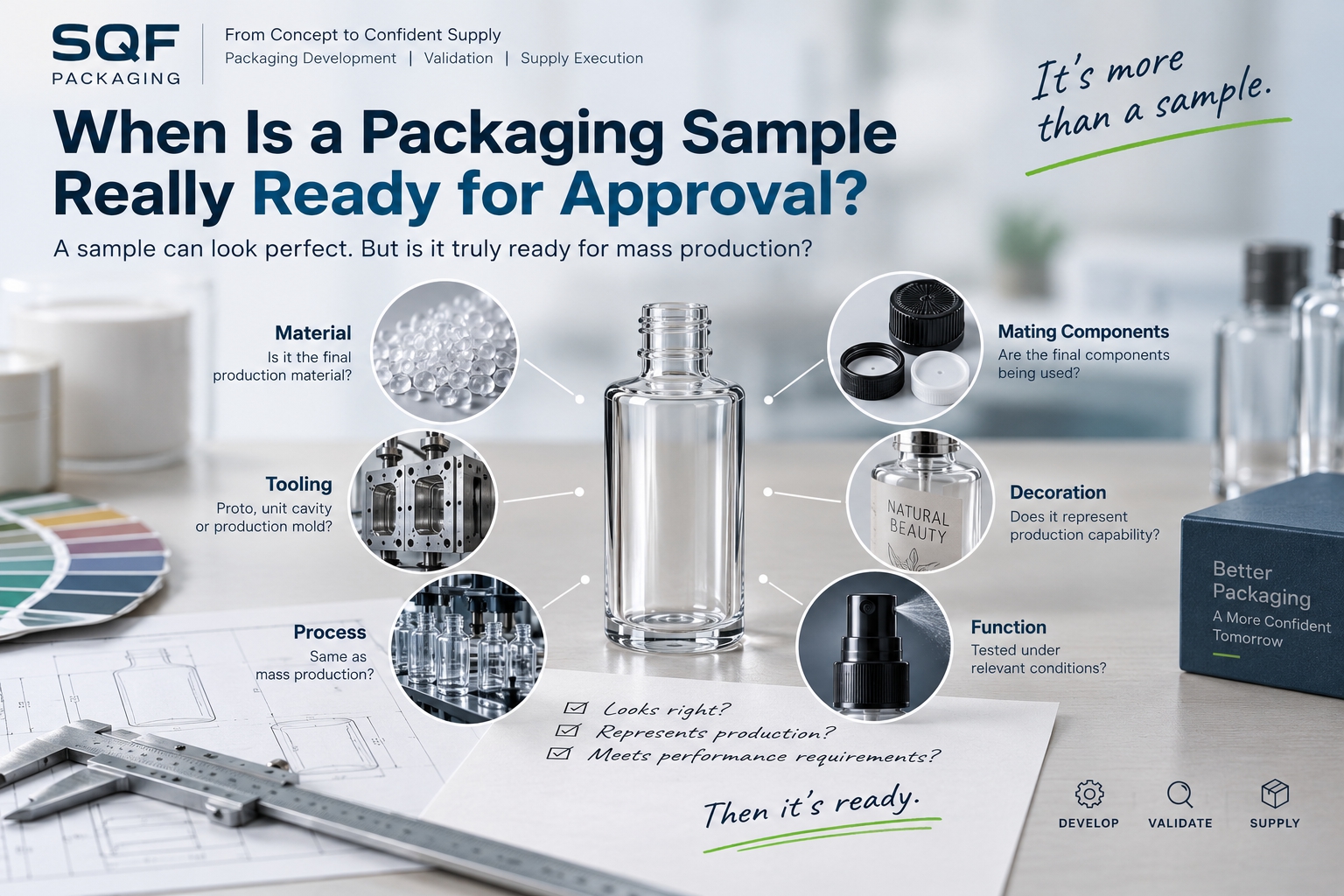
When Is a Packaging Sample Really Ready for Approval?
A packaging sample can look perfect and still be too early to approve for mass production.
The real question is not simply whether the sample looks right. It is whether the sample represents the materials, tooling, process, components and performance conditions that production will actually use.
That distinction matters because a beautiful sample and a production-representative sample are not always the same thing.
“Approved” Can Mean Very Different Things
In packaging development, the word approved is often used broadly.
A sample may be approved for:
- appearance
- color
- dimensions
- decoration
- fit
- function
- sealing
- overall production
These are not necessarily the same approval.
A color sample, for example, may establish an appearance reference without confirming dimensional performance. A prototype may confirm shape and proportions without representing the final production process.
Problems begin when a sample approved for one purpose is later treated as if it represented everything.
Approval only has meaning when the scope of that approval is understood.
A Good Sample Is Not Necessarily a Production-Representative Sample
During development, samples are often produced under conditions that are different from mass production.
That is normal.
Early samples may come from prototype tooling, a single cavity, manual assembly or a specially controlled decoration process.
They can be extremely useful for making decisions.
But they may not yet answer the question:
Can this result be reproduced consistently in production?
That requires looking beyond the finished sample itself.
1. Is It Made From the Final Production Material?
A sample may have the correct shape and appearance while using a material that is not yet the final production specification.
This can matter for:
- color
- rigidity
- flexibility
- shrinkage
- chemical resistance
- dimensional stability
- sealing behavior
- surface appearance
For some projects, an early material substitute is perfectly acceptable for evaluating design.
It simply should not be confused with validation of the final material.
The important point is knowing what the sample actually represents.
2. What Tooling Produced the Sample?
Tooling is another important distinction.
A sample produced from prototype tooling, a unit cavity or a pilot mold can confirm many aspects of the design.
But mass production may eventually use a multi-cavity production mold.
That introduces another question:
Does the approved sample represent the production tooling—or only the intended design?
This becomes especially relevant when small cavity-to-cavity differences can affect:
- dimensions
- thread engagement
- sealing
- assembly
- appearance
- component fit
A sample can therefore be correct while still not representing the full range of production variation.
3. Was the Sample Made Using the Production Process?
This question is particularly important for decoration and assembly.
A development sample may receive extra manual attention simply because only a small quantity is being produced.
Printing may be adjusted carefully.
Components may be assembled by hand.
A coating may be applied under slower or more controlled conditions.
None of this necessarily makes the sample invalid.
But if mass production will use a different process, the sample needs to be understood in that context.
The closer the sample process is to the intended production process, the more useful the sample becomes as a production reference.
4. Are the Final Mating Components Being Used?
Packaging components rarely operate independently.
A closure interacts with a bottle.
A liner interacts with both the closure and the bottle sealing surface.
A pump interacts with the bottle neck, dip tube and product.
A dropper combines the bottle, pipette, bulb, collar and formula.
This means a component can be perfectly acceptable on its own and still behave differently when assembled into the complete package.
For that reason, a sample intended to confirm system performance becomes much more meaningful when the final—or properly representative—mating components are used.
This is particularly important when components come from different suppliers.
5. Does the Decoration Represent Production?
Decoration samples deserve particular attention because visual approval can be misleading.
A hand-prepared sample may achieve excellent:
- registration
- print position
- color density
- coating coverage
- hot-stamp alignment
- label placement
But mass production introduces process speed, fixtures, equipment tolerances and normal production variation.
The question is therefore not only:
“Does this decoration look right?”
It is also:
“Does this sample represent what the production process can repeatedly achieve?”
Those are two different questions.
6. Has Function Been Evaluated Under Relevant Conditions?
A sample can pass a basic functional check and still not represent actual use.
A sprayer tested with water may behave differently with a viscous or alcohol-based formula.
A dropper bulb may respond differently after prolonged product contact.
A closure may seal during a short bench test but behave differently after transportation, temperature changes or extended storage.
The level of testing should reflect the application and the risk involved.
Not every package needs an elaborate validation program.
But when function is important, testing the right condition matters as much as testing the right component.
Sample Quality and Sample Representativeness Are Different
This distinction is useful in packaging development.
Sample Quality
How good is the individual sample in front of us?
Sample Representativeness
How well does that sample represent what will actually be produced?
A beautifully made sample can score very highly on the first question and still leave uncertainty around the second.
For production approval, both matter.
So When Is a Sample Really Ready?
There is no single rule that applies to every packaging project.
A stock bottle with an existing closure may require relatively little development.
A custom multi-component dispensing package may require several stages of sampling and validation.
But the principle remains the same:
A sample becomes a meaningful production reference when we understand not only what it looks like, but what produced it and what it represents.
That means understanding the relationship between:
Material → Tooling → Process → Mating Components → Function → Production
The closer those conditions are to the intended production system, the stronger the approval becomes.
Approval Is a Milestone, Not the End of Validation
Sample approval is important.
But it should not create a false sense that every production variable has disappeared.
Mass production introduces scale, multiple cavities, longer production runs, material batches, equipment conditions, assembly variation and other factors that a small sample set cannot fully reproduce.
This is why an approved sample works best as part of a larger control system:
Approved Sample + Specification + Production Control + Inspection + Functional Validation
The sample provides the reference.
The rest of the system helps ensure that reference can be reproduced.
A sample should not become a production reference simply because it looks right. It should become a production reference when the conditions behind it are understood.
FAQ
What is a production-representative packaging sample?
A production-representative sample is produced using materials, tooling, processes and components that reasonably reflect the intended mass-production conditions.
Can a prototype sample be approved?
Yes, for the purpose it represents. A prototype may be approved for design, appearance or another specific characteristic without necessarily representing final mass production.
Is a pre-production sample the same as an approved sample?
Not necessarily. “Pre-production sample” generally describes when the sample is produced, while “approved sample” describes its acceptance status. The terminology and approval scope should be defined for the project.
Why can a perfect sample still create problems in production?
Because the sample may not capture all production variables, including material batches, multiple mold cavities, process variation, assembly conditions and dimensional tolerance interactions.
Should packaging be tested with the final product formula?
When the product can affect material compatibility, sealing or dispensing performance, testing with the intended formula—or an appropriate representative formulation—can be important before final validation.