Vented Cap Liners: Types, Applications and Selection Guide
A vented cap liner provides a pathway for gas exchange within a compatible closure system. Selecting the right liner requires a balance between venting performance, sealing requirements and compatibility with the product being packed.
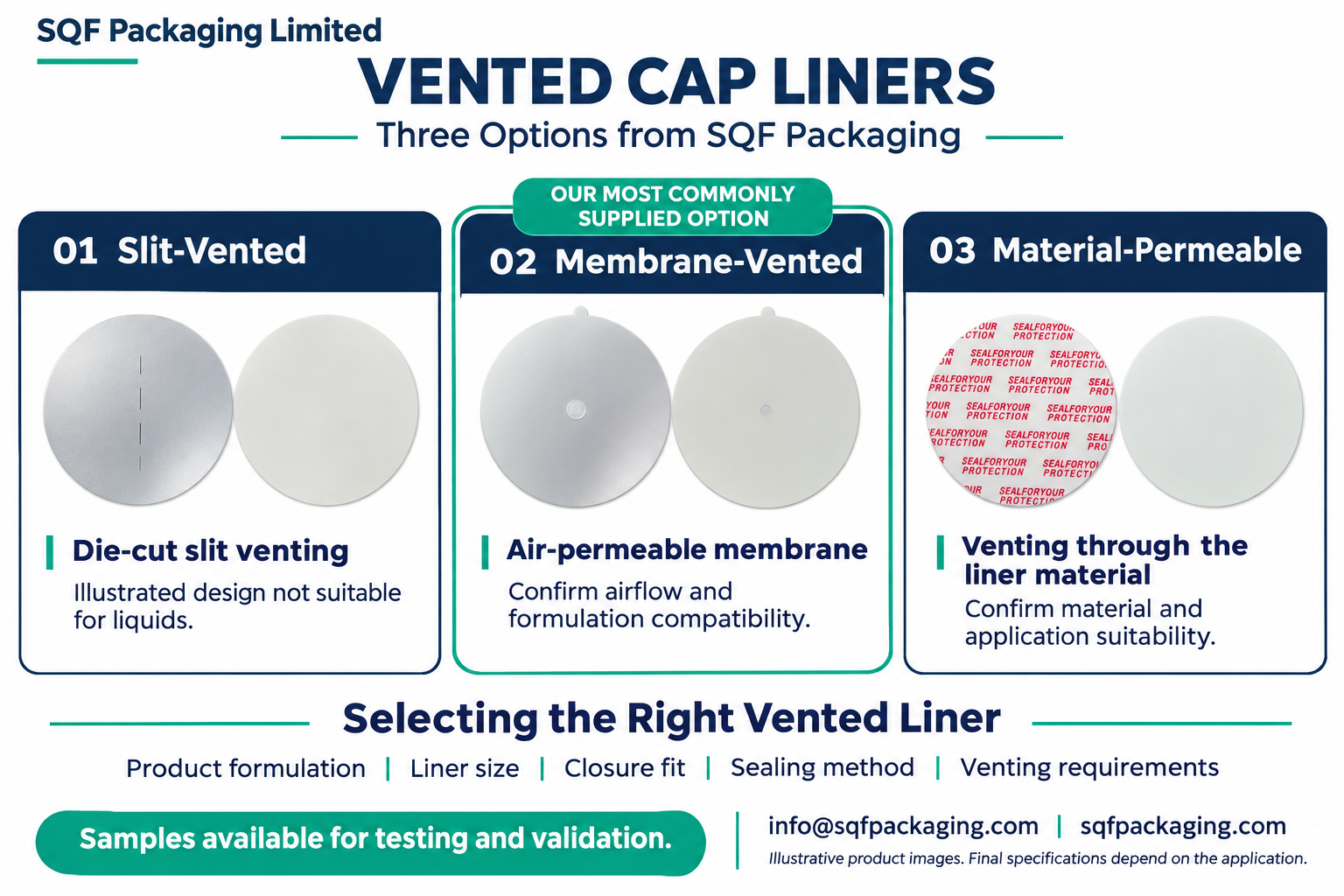
SQF Packaging Limited offers three vented liner options: slit-vented liners, membrane-vented liners and material-permeable liners. The membrane-vented design is our most commonly supplied option. The final specification depends on the product, closure, sealing process and required performance.
What Is a Vented Cap Liner?
A cap liner is an insert or sealing component used with a closure. A vented liner incorporates a pathway for gas exchange through a slit pattern, a membrane or the selected liner material.
The liner works as part of the complete package. Its performance depends on how the bottle, closure and liner function together, including whether the gas pathway remains effective after assembly and sealing.
Three Vented Liner Options from SQF Packaging
| Liner option | Venting approach | Main selection consideration |
|---|---|---|
| Slit-vented liner | Gas exchange through a die-cut slit pattern | The illustrated design is not suitable for liquids. |
| Membrane-vented liner | Gas exchange through an air-permeable membrane | Confirm membrane compatibility, airflow and the complete venting pathway. |
| Material-permeable liner | Gas exchange through the selected liner material | Confirm material compatibility and suitability for the intended product. |
These are the three options covered by SQF’s product overview. Available constructions and specifications should be confirmed for each application.
1. Slit-Vented Liners
Slit-vented liners use a die-cut slit pattern to create the venting feature.
The design shown in our overview is not suitable for liquid products. Slit depth and consistency require attention because the cuts may penetrate the full liner thickness.
This option should be evaluated against the product’s containment and venting requirements before use.
2. Membrane-Vented Liners
Membrane-vented liners incorporate a welded, air-permeable membrane. This is SQF Packaging’s most commonly supplied vented liner design.
The membrane is intended to allow gas exchange while providing resistance to water penetration. However, water resistance does not establish compatibility with every liquid formulation.
Airflow and liquid resistance depend on the selected membrane, exposed area and package configuration. These characteristics cannot be determined from appearance alone.
For the construction shown in our overview, liner diameters below 25 mm require a manufacturing feasibility review.
3. Material-Permeable Liners
Material-permeable liners rely on the permeability of the selected liner material, rather than a visible slit or a separate central membrane.
The option shown in our overview uses a one-piece paperboard construction. Unprinted liners can appear white on both sides, so the correct assembly orientation should be confirmed with the selected specification.
The illustrated material-permeable option is not suitable for highly corrosive products.
How to Select a Vented Cap Liner
Identify the Product and Formulation
Start with the product being packed, including whether it is a liquid, powder or another material.
Relevant formulation details help guide material selection. A liner that performs with water should not automatically be assumed suitable for a formulation containing oils, solvents, surfactants or other ingredients.
Testing should use the actual product.
Confirm the Bottle, Closure and Liner Dimensions
Provide the neck finish, closure details and required liner diameter.
The nominal closure size alone may not define the correct liner fit. The assembled components must support both sealing and the intended gas pathway.
Define the Sealing Process
Confirm whether the liner will be used as a compression seal or with an induction-sealing process.
For vented induction seal liners, the venting pathway must remain functional after sealing. The selected construction should be evaluated with the actual container and sealing process.
Specify the Venting Requirements
If an airflow or pressure requirement is available, share the specification together with its test method and conditions.
Where no specification exists, describe the packaging issue and expected operating conditions. This provides a starting point for selecting samples and establishing an evaluation plan.
Evaluate Storage and Transport Conditions
Testing should reflect how the package will be filled, stored, handled and transported.
Relevant factors may include temperature changes, package orientation and contact between the contents and the venting feature. Liquid contact with a membrane can affect gas exchange, depending on the design and application.
Can Vented Liners Be Used for Pharmaceutical Packaging?
There is no single vented liner specification suitable for every pharmaceutical application.
Selection starts with understanding why venting is required and what the finished package must achieve. The liner construction then needs to be evaluated against the product, packaging process and applicable requirements.
A commonly supplied membrane-vented liner should not be treated as evidence of pharmaceutical approval or suitability for a particular medicine.
SQF Packaging can provide samples for application-specific testing and validation.
Frequently Asked Questions
Which vented liner does SQF supply most commonly?
The membrane-vented liner is our most commonly supplied option. Final selection depends on the application and testing results.
Are all vented liners suitable for liquids?
No. The slit-vented design shown in our overview is not suitable for liquids. Membrane-vented options also require evaluation with the actual liquid formulation.
Does a water-resistant membrane work with every formulation?
No. Water resistance does not establish compatibility with every product. Leakage, material compatibility and venting performance should be evaluated using the actual contents.
Does a vented liner require a hole in the closure?
That depends on the complete venting design. The gas pathway through the selected liner and closure system should be confirmed before making changes to the closure.
Can SQF provide samples for testing?
Yes. We can provide samples for testing and validation. Please share the liner size, closure details, product type, sealing method and any specific venting requirements.
Request Vented Liner Samples
SQF Packaging Limited offers vented liner options to support different packaging requirements.
To request suitable samples, send us:
-
Required liner diameter and closure details
-
Product type and relevant formulation information
-
Sealing method
-
Venting specifications, if available
-
Intended storage and transport conditions
We will help identify suitable options for your testing and validation.
Email: info@sqfpackaging.com
Website: www.sqfpackaging.com