Why Phenolic Closures Still Matter for Demanding Applications | SQF Packaging
With so many plastic closure materials available today, why are phenolic closures still widely used for essential oils, extracts, laboratory products and other demanding formulations?
The answer is not simply tradition.
Phenolic resin provides a combination of rigidity, rigidity, dimensional stability and resistance to elevated temperatures that remains valuable in applications where an ordinary general-purpose plastic closure may not be the preferred option.
However, the phenolic shell is only one part of the closure system. The liner, bottle neck finish, application torque and product formulation must also work together.
What Is a Phenolic Closure?
A phenolic closure is a molded thermoset resin cap. Phenolic closures are also commonly called Bakelite caps, although Bakelite was originally a specific trade name associated with early phenolic plastics.
Unlike thermoplastic materials, which can soften again when exposed to sufficient heat, thermoset phenolic resin forms a permanently cross-linked structure during molding. This gives the finished closure a hard, rigid form and good dimensional stability.
Phenolic closures are often recognized by their:
-
Hard and rigid construction
-
High-gloss black appearance
-
Ribbed sides for gripping
-
Resistance to elevated temperatures
-
Availability with application-specific liner systems
Black is the most familiar color, but selected sizes may also be available in white or customized colors.
What Are the Advantages of Phenolic Closures?
1. Rigidity and dimensional stability
Phenolic resin produces a hard closure shell that maintains its shape well under normal application and storage conditions.
This rigidity can help the closure engage consistently with the bottle thread and transfer the applied torque to the liner. It is especially useful in applications where a soft or highly flexible cap would not provide the desired handling or package appearance.
2. Resistance to elevated temperatures
As a thermoset material, phenolic resin does not behave like an ordinary thermoplastic when exposed to heat. It is therefore frequently selected for laboratory, pharmaceutical and specialty packaging applications involving elevated processing or storage temperatures.
This does not mean every phenolic closure is suitable for every high-temperature process. The resin formulation, liner material, bottle and exposure conditions must all be reviewed before use.
3. A distinctive premium appearance
The smooth top, deep black color and polished finish of a phenolic closure create a recognizable technical and premium appearance.
This makes phenolic caps popular not only in laboratory packaging, but also for essential oils, flavor extracts, fragrances, tinctures and other products where the closure contributes to the overall presentation of the package.
4. Multiple liner possibilities
The performance of a lined closure depends heavily on the liner selected for the application.
A PE cone liner is one of the most familiar options used with phenolic closures. When the cap is tightened, the cone-shaped liner contacts the top and inner edge of the bottle opening. This creates a wedge-style sealing interface rather than relying only on a flat surface seal.
Depending on the application, other liner constructions may also be considered. Each liner material has different characteristics when exposed to oils, alcohols, solvents, acids, alkalis or other ingredients.
The liner should therefore be selected according to the actual formulation—not merely according to the closure diameter.
Where Are Phenolic Closures Commonly Used?
Phenolic closures are frequently considered for:
-
Essential oils
-
Fragrance oils
-
Flavor extracts
-
Tinctures
-
Laboratory reagents
-
Analytical standards
-
Pharmaceutical and nutraceutical liquids
-
Specialty chemicals
-
Products requiring a rigid, technical-looking closure
Suitability cannot be determined from the market category alone. Two essential oil formulations, for example, may interact differently with the same liner because of differences in their ingredients and concentrations.
Available Phenolic Closure Sizes
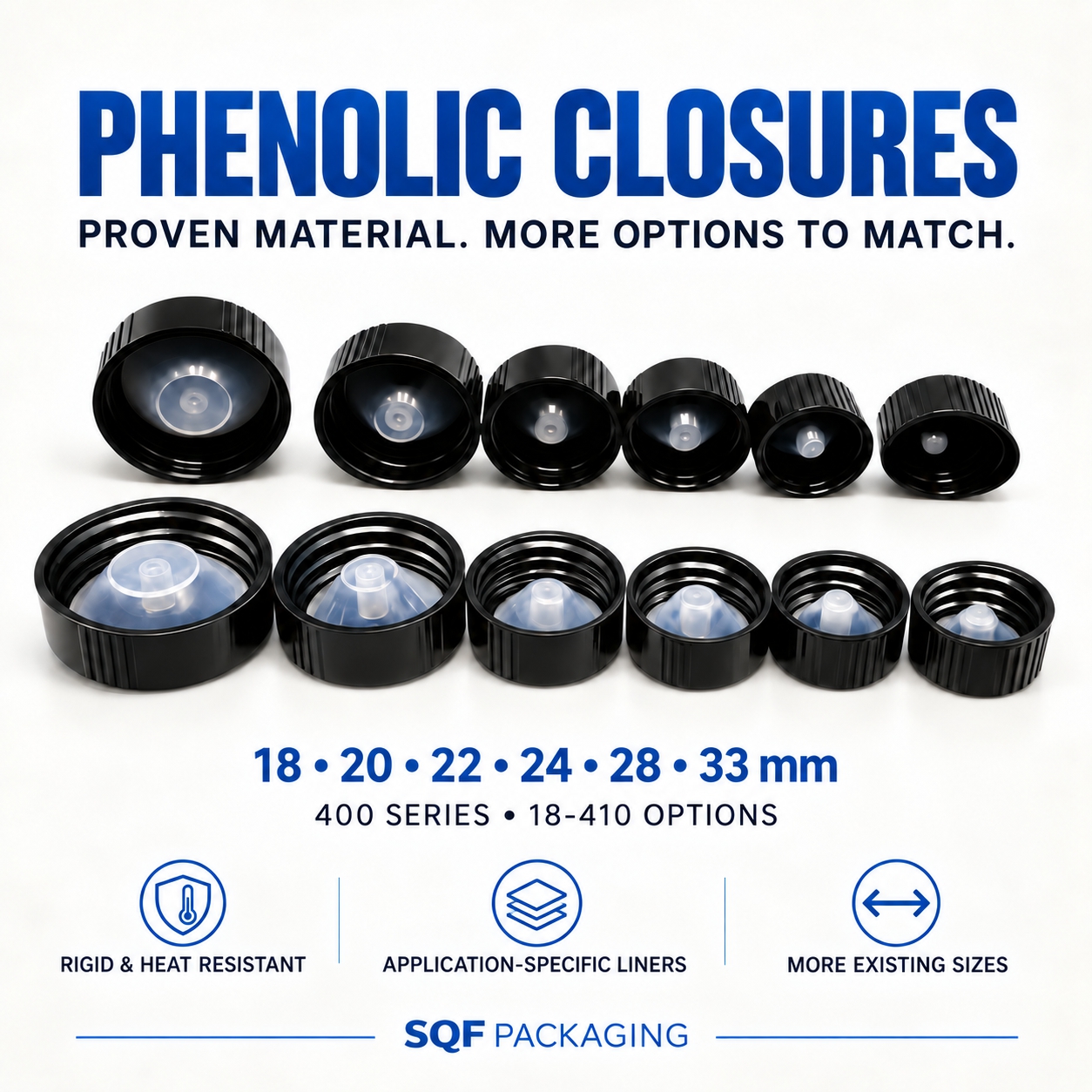
SQF Packaging offers an established range of phenolic closures for commonly used bottle neck finishes:
-
18-400
-
20-400
-
22-400
-
24-400
-
28-400
-
33-400
-
Selected 18-410 options
The value of having multiple existing sizes is not that one customer needs to purchase the entire range.
It means that a brand, distributor or contract packager has a better chance of finding a closure that matches an existing bottle without beginning with a new closure mold.
This can be particularly useful when:
-
Replacing an existing closure supplier
-
Matching an established Boston round bottle
-
Adding another bottle capacity to a product line
-
Maintaining a consistent closure appearance across several SKUs
-
Developing a package in a lower initial quantity
-
Avoiding unnecessary tooling costs and development time
Why the Neck Finish Must Be Confirmed
A diameter such as 18 mm or 24 mm does not provide enough information to select a closure.
For example, an 18-400 closure and an 18-410 closure have the same nominal neck diameter, but the thread design and finish dimensions are different. They should not be treated as interchangeable.
The complete neck-finish designation, bottle drawing or physical bottle sample should be reviewed before confirming compatibility.
The following factors may affect the final fit and sealing performance:
-
Neck-finish standard
-
Bottle thread dimensions
-
Bottle material
-
Manufacturing tolerances
-
Closure thread dimensions
-
Liner design and thickness
-
Application torque
-
Product formulation
-
Filling and storage conditions
Compatibility Testing Is Still Necessary
Terms such as “chemical resistant,” “oil resistant” or “leak resistant” should not be interpreted as universal guarantees.
Chemical compatibility is a property of the complete packaging system—not the phenolic shell alone.
Before commercial production, the proposed closure should be tested with:
-
The actual production bottle
-
The intended liner
-
The real product formulation
-
The planned application torque
-
The expected filling, transportation and storage conditions
Testing may include leakage evaluation, torque retention, inversion, temperature exposure and longer-term compatibility observation.
Selecting the Right Phenolic Closure
A suitable phenolic closure should be selected by answering four basic questions:
-
What is the bottle’s complete neck finish?
-
Which liner is appropriate for the formulation?
-
What application torque will be used?
-
Under what conditions will the finished package be filled, transported and stored?
SQF Packaging supports phenolic closure projects from initial size identification and liner selection through sampling, bottle matching and compatibility evaluation.
A broader selection of existing sizes makes sourcing easier—but the final decision should always be based on the complete closure, liner, bottle and formulation combination.
For specifications, samples or a phenolic closure project evaluation, contact SQF Packaging.