Why an Approved Packaging Sample Can Still Differ from Mass Production
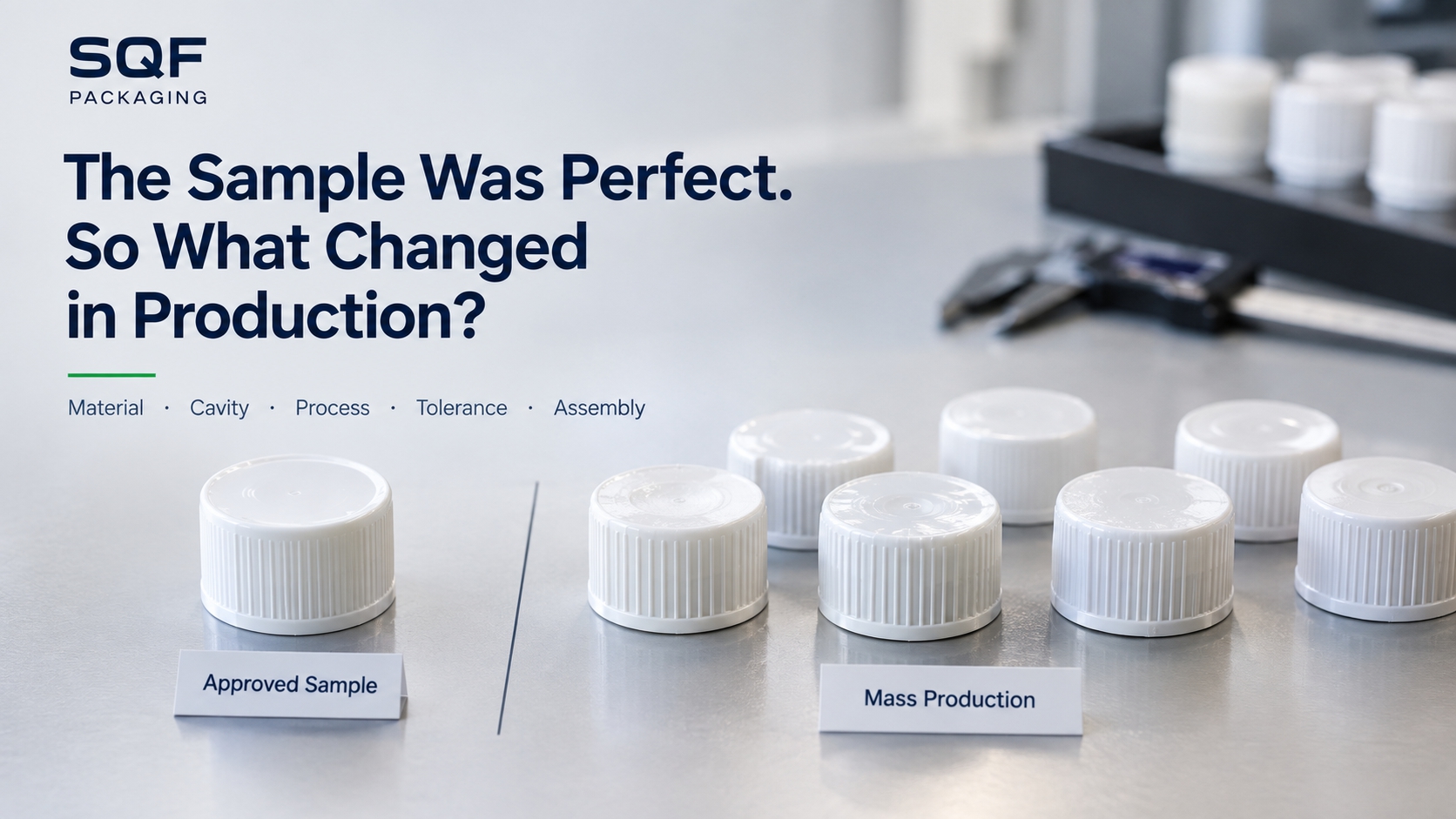
An approved packaging sample is an important production reference, but it does not guarantee that every unit in mass production will be identical to that sample.
The reason is simple: a sample represents a small number of components produced under specific conditions, while mass production introduces variation across materials, mold cavities, machines, process settings, decoration and assembly.
The goal of sample approval should therefore not be to eliminate all variation. It should be to define which characteristics are critical, what variation is acceptable, and how those requirements will be controlled during production.
Why Can Mass Production Differ from the Approved Sample?
A common question from packaging buyers is:
“The sample was approved. Why does production look or perform differently?”
There is rarely one single reason.
In packaging manufacturing, variation can come from several stages of the process:
- raw material batches
- different mold cavities
- molding conditions
- dimensional tolerances
- color matching
- printing and decoration
- component assembly
- production equipment
- operator handling
Individually, each variation may still be within specification.
The problem becomes more complicated when several tolerances interact within one finished package.
1. An Approved Sample May Represent Only One Mold Cavity
A sample set may contain parts produced from only one cavity, or from a limited number of cavities.
Mass production may use a multi-cavity mold.
Even when every cavity is within specification, small differences can exist between cavities in dimensions, surface appearance, parting lines or other characteristics.
This is why validation based on only one visually perfect sample can sometimes give an incomplete picture of production capability.
For critical packaging components, it can be useful to evaluate samples across multiple cavities where practical.
2. Raw Material and Color Batches Can Introduce Variation
Plastic resin, masterbatch, glass, metal coatings, inks and other packaging materials can vary between production batches.
Color is one obvious example.
A laboratory sample or pre-production sample may match the approved color very closely, while subsequent production can show a small but visible difference.
Instead of relying only on visual judgment, critical color requirements can be defined using an agreed reference, measurement method and acceptable tolerance where appropriate.
3. Production Conditions Are Not Identical to Sampling Conditions
Sampling and mass production do not always run under exactly the same conditions.
During a full production run, factors such as:
- temperature
- pressure
- cycle time
- cooling
- machine speed
- tooling condition
can influence the final component.
A dimensional difference does not automatically mean the component is defective. The important question is whether the variation remains within the agreed specification and whether it affects package performance.
4. Dimensional Tolerances Can Stack Up
This is one of the most important packaging issues—and one of the easiest to overlook.
Imagine a bottle and closure that each have acceptable manufacturing tolerances.
The bottle may be toward one end of its tolerance range, while the closure may be toward the opposite end.
Both components can individually pass inspection, yet the assembled package may behave differently from the approved sample.
This is known as tolerance stack-up.
It is particularly important when evaluating:
- bottle and closure fit
- thread engagement
- liner compression
- dispensing components
- snap-fit assemblies
- pumps and actuators
- assembled packaging systems
This is why component specifications alone do not always predict finished-package performance.
5. Decoration Adds Another Source of Variation
Printing, hot stamping, coating, spraying, metallization and labeling introduce additional processes after the primary package has been manufactured.
Each process has its own tolerances.
Possible differences include:
- print position
- color density
- registration
- coating thickness
- gloss
- label alignment
- decorative coverage
A visually perfect decorated sample should therefore be accompanied by clearly defined acceptance criteria wherever appearance is critical.
6. Assembly Can Create Problems That Individual Components Do Not Show
A bottle may pass inspection.
A closure may pass inspection.
A liner may pass inspection.
And yet the assembled package may still fail.
Why?
Because assembly creates interactions that cannot always be evaluated by inspecting individual components separately.
Examples include:
- insufficient liner compression
- incorrect application torque
- poor thread engagement
- inconsistent snap fit
- component interference
- assembly orientation
- functional incompatibility
This is particularly important for packaging made from components supplied by different manufacturers.
Does This Mean an Approved Sample Is Not Useful?
No.
An approved sample is extremely useful.
The problem is expecting it to do something it cannot do.
An approved sample is best used as a physical reference for agreed characteristics such as:
- appearance
- color
- decoration
- general workmanship
- component configuration
- assembly
- functional expectations
But it should work together with drawings, specifications, tolerances and test requirements.
A sample shows what was approved.
A specification defines what production is allowed to vary.
Both are important.
What Should Be Defined Before Mass Production?
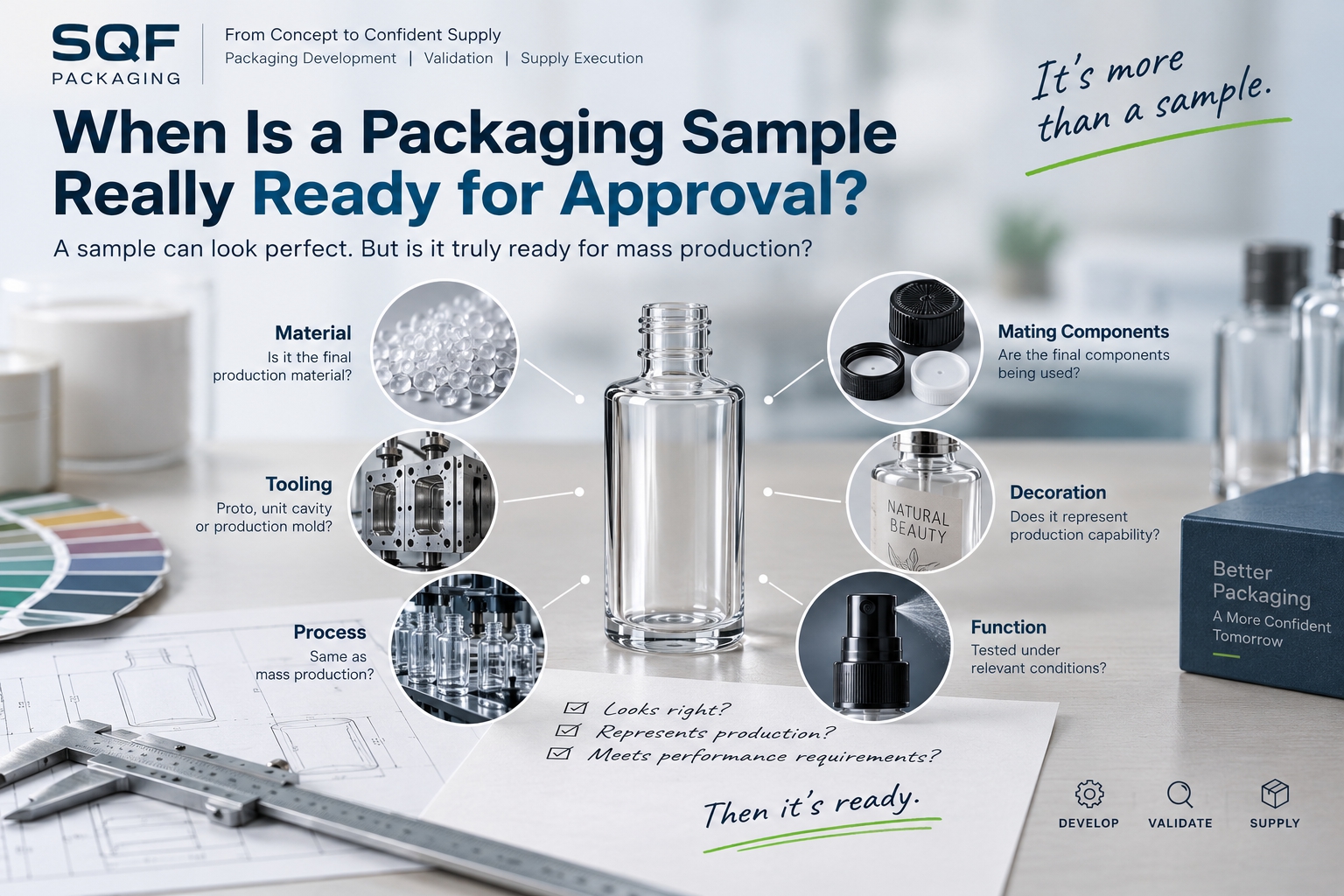
Before production begins, buyers and suppliers should identify the characteristics that matter most to the package.
Depending on the product, these may include:
Appearance
Color, surface finish, decoration, visible defects and workmanship.
Dimensions
Critical dimensions affecting compatibility, filling, assembly or downstream equipment.
Fit
Bottle-to-closure, pump-to-bottle, component-to-component or other interfaces.
Function
Dispensing, spraying, pumping, opening, closing, child resistance or other intended functions.
Sealing
Leak resistance, liner compression, induction sealing or other sealing requirements.
Performance
Drop resistance, torque, pressure, transportation or application-specific testing.
Not every characteristic needs the same level of control.
The important step is identifying critical-to-quality characteristics before production, rather than after a problem occurs.
Why Final Inspection Still Matters
Production control reduces variation, but final inspection remains important.
Inspection can help identify problems involving:
- appearance
- dimensions
- assembly
- function
- packaging
- labeling
- workmanship
However, inspection should not be viewed as the process that “creates” quality.
Quality needs to be built into the manufacturing and validation process before final inspection begins.
Some problems can also be difficult to detect through automated inspection alone.
A vision system can evaluate characteristics it has been programmed to recognize. It may not identify every unexpected functional, assembly or compatibility issue.
That is why appropriate functional checks and physical sampling can still play an important role.
How Can Buyers Reduce the Gap Between Sample and Production?
A practical approach is to treat approval as a process rather than a single signature on a sample.
Before mass production:
- Confirm the correct component specifications.
- Identify critical-to-quality characteristics.
- Define acceptable tolerances where necessary.
- Approve representative physical samples.
- Confirm functional and compatibility requirements.
- Define appropriate production and final inspection methods.
- Retain approved samples for comparison when practical.
For packaging systems involving multiple components, validation should also consider how those components perform together, not just individually.
The Real Purpose of an Approved Sample
The objective is not to make every production unit visually identical to one hand-selected sample.
The objective is to establish a controlled reference that connects:
Sample → Specification → Production → Inspection → Performance
When those elements are aligned, an approved sample becomes much more valuable than a visual reference.
It becomes part of the production control system.
A perfect sample does not guarantee perfect production.
Good validation defines which differences matter before production begins.
FAQ
What is an approved packaging sample?
An approved packaging sample is a physical sample accepted by the buyer and supplier as a reference for specified characteristics such as appearance, color, decoration, configuration, fit or function.
Should mass production be exactly the same as the approved sample?
Mass production should meet the agreed specifications and acceptance criteria, but normal manufacturing variation means every unit may not be visually or dimensionally identical to one sample.
Why can a production part be within tolerance but still cause a problem?
Two or more components can each be within their individual tolerances while their combined dimensions create an unfavorable fit or functional condition. This is commonly referred to as tolerance stack-up.
Should samples from every mold cavity be approved?
Not necessarily in every project. However, for critical multi-cavity components, cavity-to-cavity variation may need to be considered during validation and production control.
Is an approved sample enough for packaging quality control?
Usually not by itself. Approved samples are most effective when used together with drawings, specifications, tolerances, test requirements and inspection criteria.
Can 100% inspection guarantee that packaging has no defects?
Not necessarily. Inspection systems detect characteristics they are designed or configured to evaluate. Some functional, compatibility or unexpected assembly issues may require additional physical or functional testing.